The Hearten House Clinical Model
Our Approach
We are Reimagining Mental Health Care℠
Most therapy happens in conversation. You describe what is happening. The therapist listens, reflects, responds. Over time, through language, some things shift.
Some things do not.
There is a whole category of human experience that language struggles to reach. The thing that tightens in your chest before you can name what you are feeling. The way your body braces before you are consciously aware of threat. The memory that lives somewhere below the story you tell about it. The pattern that you understand completely and keep repeating anyway.
At Hearten House, we work with all of it. Not just the part that has words.
Experiential therapy is effective and efficient because it engages your brain, your nervous system, your body, your relationships, and your story.
The Hearten House Clinical ModelOur clinical model is experiential, embodied, and trauma-informed.
These are not buzzwords. They describe a specific way of working that is grounded in research, held to rigorous clinical standards, and delivered by licensed clinicians trained specifically in these approaches.
Experiential means the work happens in action, not just in reflection. You bring your experience into the room and engage with it directly, through enactment, movement, creative expression, or structured encounter with others.
Embodied means we work with the whole person, including the nervous system and the body. Trauma and overwhelming experience are stored in the body, not only in conscious memory. Healing requires attending to what the body holds alongside what the mind understands.
Trauma-informed means that every aspect of how we operate, the space, the intake process, the group structures, the clinical relationships, is shaped by what we know about trauma and what people need to feel safe enough to heal. Trauma-informed care is not a technique. It is the operating framework beneath everything we do.
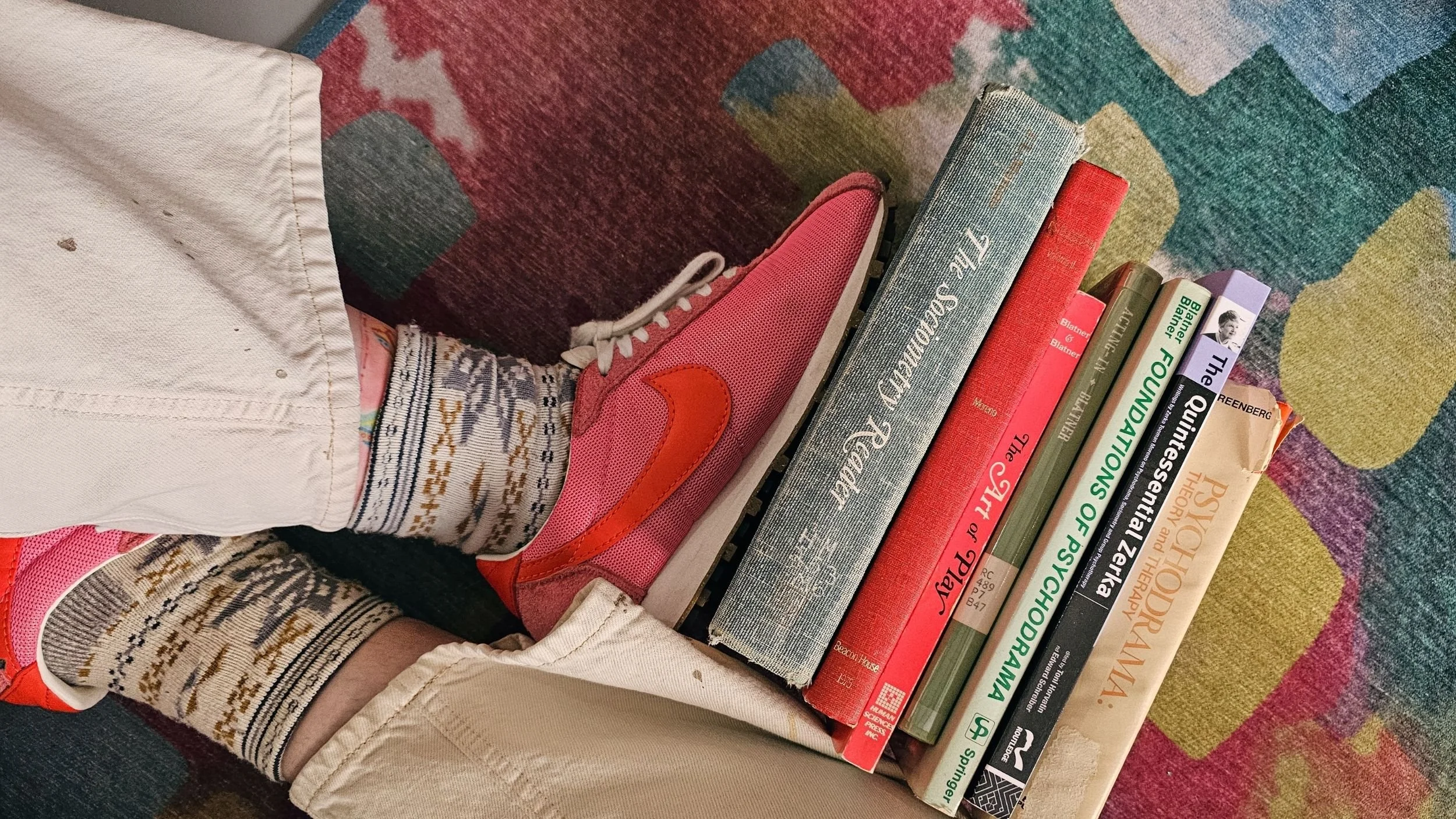
At the center of our clinical model is psychodrama, one of the oldest and most extensively researched forms of group psychotherapy in the world. Psychodrama works by bringing experience into the room rather than only talking about it, engaging the body, relationships, and action in service of integration and healing. It is not the only method we use, but it is the primary lens through which we work.
The "Who" behind the "How"Hearten House was founded in 2017 by Aimee Hadfield, LCSW, CP, PAT
After opening our physical location in 2020 as a space for small therapy and wellness businesses to gather and grow, Aimee found and fell in love with psychodrama and other embodied experiential therapy methods. What drew her to them was the realization of how quickly change happened in her own life as a participant in psychodrama after a lack of results with traditional talk therapy alone. Aimee is one of only three board-certified psychodramatists in the state of Utah. Her training spans multiple institutes and lineages, and her clinical work is deeply rooted in the integrated use of psychodrama, somatic, expressive, and action-based approaches.
The Hearten House clinical team brings training in experiential methods across the full range of approaches described on this page. We are also an NBCC Approved Continuing Education Provider, which means we hold ourselves to the same standards of rigor in training that we bring to clinical care.
Hearten House is the only fully experiential-based outpatient mental health treatment center in our region. Experiential therapy isn’t an add-on to our model, it is our model.
The Methods We Use
What we’re built onThese two pages describe the framework and the clinical lens that everything else at Hearten House is built on. They are worth reading first if you want to understand how we think about care.
The organizing framework for everything we do. What it means when it is real, and what the principles of trauma-informed approaches look like in practice.
The direct clinical treatment of trauma by trained, licensed clinicians. What it is, who it is for, and how it differs from trauma-informed care.
Our theoretical foundationPsychodrama and its companions Sociometry and Group Psychotherapy form the method the clinical model at Hearten House extends from. Psychodrama is just one of many methods we use, and everything else we do is informed by its principles.
Instead of talking about your experience, you bring it into the room. Action, enactment, and the drama of the psyche as a path to integration.
Brain and nervous system These methods work directly with how memories are stored neurologically, reaching places that language and insight cannot always access.
Where you look affects how you feel. A brain-body approach that uses specific eye positions to access and process what is stored below conscious awareness.
Eye Movement Desensitization and Reprocessing. One of the most extensively researched trauma treatments in the world. Endorsed by the WHO and the APA.
Body-based approachesWorking with the nervous system and physical experience as the terrain of healing. For what the body holds that words have not yet reached.
Your body has been keeping track. Movement therapy listens to what it has been holding and gives it somewhere to go.
Trauma-sensitive yoga as a path back to the body. Invitational, paced to you, and never about performance.
The breath is a direct pathway to your nervous system. Therapeutic breathwork uses that connection intentionally.
Sound has measurable effects on the nervous system. Soundbaths and therapeutic sound use frequency and vibration as a path to regulation and release.
Expressive and creative therapyThese methods use making, image, sound, and sensory experience as therapeutic vehicles. You do not need to be artistic. You just need to be willing.
Expression as a path to integration. Visual art, writing, music, and more, used to access what language alone cannot reach.
A tray of sand and hundreds of small figures. You build something. Then you look at what you built. What becomes visible is often surprising.
Nature and Outdoor Therapy Healing does not only happen indoors. The natural world is a clinical instrument, and some of the most significant work at Hearten House happens outside of it.
Nature-Based, Outdoor, and Adventure Therapy
The nervous system did not evolve in an office. Nature-based, outdoor, and adventure approaches use the natural world as part of how healing happens.
These methods are not used in isolation. At Hearten House, they are woven together within a coherent clinical model, chosen based on the person, the moment, and what is clinically appropriate.
A session might begin with breathwork to support regulation, move into a psychodrama scene to bring something into the room, and close with a somatic practice to support integration. A group might warm up with sociometrics, move into action through creative expression, and land in the resonance of the sharing circle.
The combination of methods is not arbitrary. It is Aimee Hadfield’s CO-CREATE Framework© in practice: a clinical approach that co-creates the experience with the participant rather than delivering a predetermined protocol.
This is what makes Hearten House different from practices that offer one or two experiential methods as an add-on to a primarily talk-based model. Here, the experiential model is the model. The methods you read about on this page are how we work with everyone, at every level of care.
How these methods work together
your questions about our experiential approach, answered
-
Experiential therapy is an approach to psychotherapy that uses action, enactment, creative expression, and embodied experience rather than relying solely on verbal conversation. Instead of only talking about what happened, clients engage with their experience directly, through movement, role work, creative making, or other non-verbal approaches. Experiential therapy is grounded in research and used across a range of clinical presentations.
-
Embodied therapy refers to approaches that work with the body and nervous system as central to the healing process, not just the thinking mind. Trauma and overwhelming experience are stored in the body, not only in conscious memory. Embodied approaches engage physical sensation, movement, and nervous system regulation alongside cognitive and verbal processing.
-
Talk therapy works primarily through language and cognitive understanding. Experiential therapy engages additional channels: action, movement, creative expression, sensory experience, and the nervous system. The two are not opposites and are often used together. Experiential approaches are particularly effective for experiences that resist articulation or that have not responded to talk therapy alone.
-
Yes. The methods used at Hearten House, including psychodrama, EMDR, brainspotting, somatic approaches, creative arts therapy, and others, each have their own evidence base. The broader experiential and embodied approach is increasingly supported by trauma research, including the work of Bessel van der Kolk, Peter Levine, Pat Ogden, and others. Clinical care at Hearten House is held to rigorous standards and delivered by licensed clinicians.
-
No. The methods used in your care are chosen collaboratively based on your needs, your readiness, and what is clinically appropriate. You are never asked to do something before you are ready. Your pace and your choices guide the work throughout.
-
Yes. Many people who come to Hearten House have no prior experience with experiential methods. The warm-up is part of how the work makes itself accessible. You do not need to understand the methods to benefit from them. You just need to be willing to try something that might feel unfamiliar.
Not sure where to start?
A free consultation is a conversation, not a commitment. We will help you understand what kind of support makes sense for where you are, and whether Hearten House is the right fit.